The European
Currency:
The European
Currency:
The Euro
A WebQuest for 8th, 9th, and 10th Grade (German)
Designed by
 Alexander
Breitkreutz
Alexander
Breitkreutz
albtz@comcast.net
Introduction | Task | Process | Evaluation | Conclusion | Credits
Introduction
Over the next four days, you are going to explore the common currency (money) of the Euro Zone. After completing your project, you will be able to answer the following essential questions:
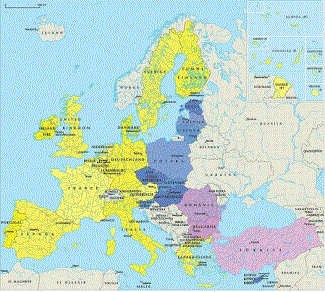
· 12 member states of the European Union use the same currency but not all states of the European Union participate in this monetary union
· What are the face values for Euro bills and coins?
· What are the symbols, materials, and safety features for the Euro coins and bills?
You will be able to:
· Distinguish between member states of the Euro zone and European Union
· Identify Euro bills and coins; materials; symbols; denominations
· Apply and extend your knowledge of safety features of US $ to Euros
· Apply the German terminology for currency, numbers, and countries
 Task
Task
The following description will help you to understand the situation and expectations:
Goal: You are a team of three to four managers of a big US bank. Your boss asked you to compare and contrast the Euro with the US Dollar.
Role: You are a high-ranking manager in one of the biggest banks of the United States
Audience: The board of the bank
Situation: You have been asked by the board to do a research on the Euro. The board wants to find out about differences and similarities of the European and the US currency.
Performance and Purpose: You have been asked to analyze the European currency. Find out which states participate, what bills and coins look like, and what the safety features are. You should describe these details and be able to compare at least two features with the US Dollar.
Standards and Criteria for Success:
You have to clarify the difference between member countries of the Euro currency and the European Union. Present denominations, materials of coins, symbols, and safety features of the Euro. Use German terminology on main criteria (see page 3). Prepare to present your work before the board and hand in a 2-pages summary with your presentation

Process
Step 1 - As mentioned above, you will be part of a team of 3-4 students. Choose your team members. The workload should be distributed equally among the team members. At the end of the project, each team member will assess the participation of the other team members anonymously, which will have an influence on your final grade for the project.
Step 2 - Discuss with your team members how you are going to approach the project and how you are going to share the workload. You may split up among your group once you have collected the required information and have one part of your group work on your paper and the other part on the presentation.
Step 3 – Answer the following questions using the links under “Credits”:
· What is the symbol for the Euro?
· List all countries where the Euro is the official form of payment
· Describe the difference between the Euro Zone and the European Union
·
 How
many Euro banknotes are there
How
many Euro banknotes are there
· How many Euro coins are there?
· What are the denominations for these coins?
· What symbols are being used on bills and coins?
· Are the symbols the same or different on the front and back of bills and coins?
· What materials are being used for bills and coins?
· What are the safety features for the Euro bills?
· Compare at least one safety feature of the US $ to the Euro! Are they the same or different?
· What is an exchange rate (definition)?
· What is the exchange rate between the US $ and the Euro?
· On what date became the Euro the official form of payment (or when did the Euro “money” actually come out)?
· Discuss at least 2 characteristics between the US$ and the Euro that are different or the same
· Translate the following words into German and include them in your text (in parenthesis):
o Currency
o
 Money
Money
o Bill
o Coin
o European Union
o Pay (verb)
Step 4 – Write a 2-paged paper and prepare a presentation. The paper should answer all those questions from Step 3. Type your paper; use double space with 1-inch margins. The font size should be 12 in either Times New Roman or Arial. Hand in your final paper including the names of all members of your team. Make sure to answer all questions as outlined under Step 3. Be neat; correct all spelling errors before you hand in your team project.
Prepare a presentation. Answer all questions from Step 3 orally and support them with pictures, drawings, quotes, etc. You may use a poster board, etc. Be creative!
Keep the situation setting in mind, as described under “Task”, when you work on your paper and presentation.
Step 5 – Turn in your final paper and be prepared to present your findings no later than
 Determine the due date here
Evaluation
You will be evaluated in six categories. Keep in mind that your team members will evaluate your participation and input under “Workload”.
|
CATEGORY |
7 |
5
|
3
|
1
|
|
|
Covers
the materials, symbols, denominations, and safety features of the Euro
in-depth with details and examples.
Compares and contrasts at least 2 features of the Euro and the US
Dollar. |
Includes
essential knowledge about materials, symbols, denominations, and safety
features of the Euro. Compares and contrasts at least 1 feature of the Euro
and the US Dollar |
Includes
essential information about materials, symbols, denominations, and safety
features of the Euro. Does not compare and contrast features of the Euro and
the US Dollar |
Actual
information about materials, symbols, denominations, and safety features of
the Euro is minimal OR there are several factual errors. |
|
|
Well-rehearsed
presentation with smooth delivery that holds audience attention. All German
words are pronounced correctly |
Rehearsed
presentation with fairly smooth delivery that holds audience attention most
of the time. There are very few mispronunciations. |
Delivery
not smooth, but able to maintain interest of the audience most of the time.
There are several mispronunciations. |
Delivery
not smooth and audience attention often lost. Presenters did not seem
confident about the material being presented. |
|
|
Content
is well organized using headings or bulleted lists to group related material.
|
Uses
headings or bulleted lists to organize, but the overall organization of topic
appears flawed. |
Content
is logically organized for the most part. |
There
was no clear or logical organizational structure, just lots of facts. |
|
|
The
workload is divided and shared equally by all partners. |
The
workload is divided and shared fairly by all partners, though workloads may
vary from person to person. |
The
workload was divided, but one person of the group is viewed as not doing
his/her fair share of the work. |
The
workload was not divided. One person was viewed as not doing his/her fair
share of the work. |
|
|
Text
is appropriate in length for target audience and to the point. |
Paper
is more than 2 pages in length and/or has a few misspellings |
Overall
readability is difficult with lengthy paragraphs and/or paper is less than 1
page in length and/or has some misspellings. |
The
text is extremely difficult to read. The paper is less than 1 page in length
and/or has many misspellings. |
|
|
All
requirements are met and exceeded. |
One
requirement was not completely met. |
Two
to five requirements were not completely met. |
More
than five requirements were not completely met. |


Max. points possible: __42__
Your score: _______
Conclusion
Congratulation on your effort! Your boss was very impressed with the findings and presentations of his managers. You made truly clear to him what the Euro is about and provided lots of detailed information. Therefore, he would like to offer a promotion and a higher pay to all of you.

Credits & References
Internet Sources you may refer to:
http://europa.eu.int/euro/entry.html
à click on “Find
out more about Europe's currency”
http://www.euro.ecb.int/en.html
http://dict.leo.org/ende?lang=de à an excellent translation engine; enter the word (it does not matter whether it is an English or German word) in the box on top which says “Suchbegriff” and hit the button “Suchen”
http://www.ecb.int/ecb/history/emu/html/index.en.html
http://www2.ignatius.edu/faculty/turner/EuroGuide.pdf
http://www.dw-world.de/dw/article/0,1564,371846,00.html
For your project you may also use your own Internet sources, books from the library, and your notes. You may ask your teacher for help at any time.